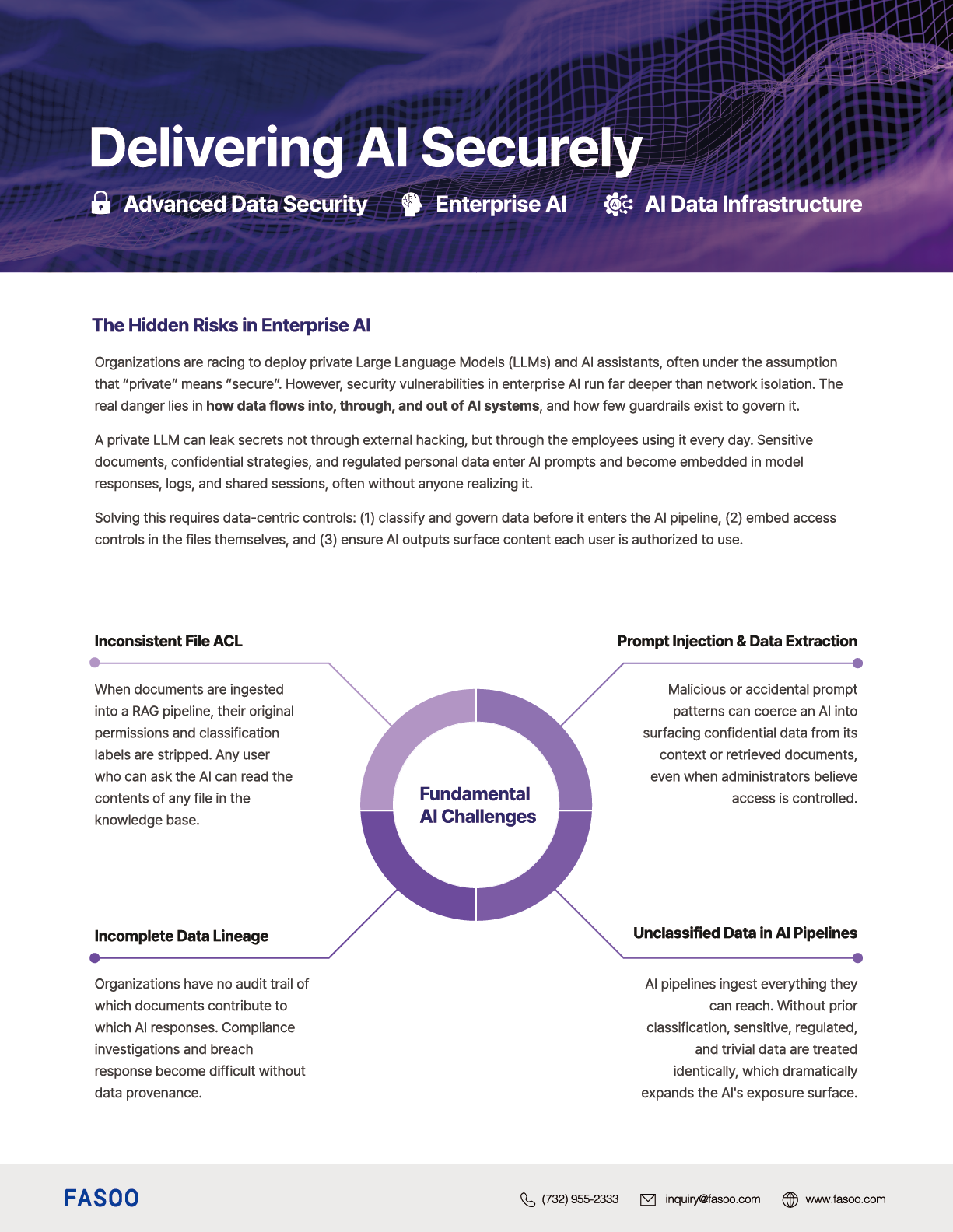
Organizations are racing to deploy private Large Language Models (LLMs) and AI assistants, often under the assumption that “private” means “secure”. However, security vulnerabilities in enterprise AI run far deeper than network isolation. The real danger lies in how data flows into, through, and out of AI systems, and how few guardrails exist to govern it.
A private LLM can leak secrets not through external hacking, but through the employees using it every day. Sensitive documents, confidential strategies, and regulated personal data enter AI prompts and become embedded in model responses, logs, and shared sessions, often without anyone realizing it.
Solving this requires data-centric controls: (1) classify and govern data before it enters the AI pipeline, (2) embed access controls in the files themselves, and (3) ensure AI outputs surface content each user is authorized to use.